
How to Use AI Marketing Tools to Grow Your Small Business Faster in 2026
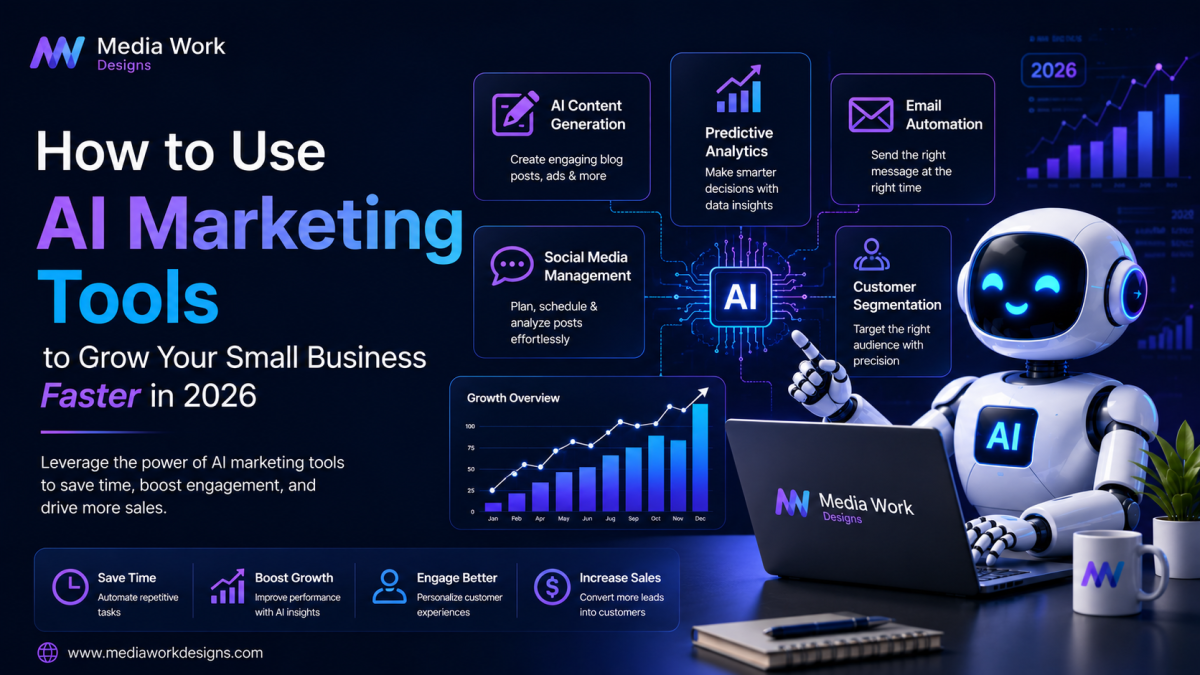
AI marketing tools have moved from ‘nice to have’ to ‘competitive necessity’ in 2026. From AI-generated content and automated ad optimization to predictive analytics and chatbots, smart businesses are using AI to work faster, smarter, and more profitably.
Introduction
Artificial intelligence is no longer a futuristic concept reserved for large enterprises. In 2026, AI has become one of the most valuable resources for small businesses looking to compete with larger brands while operating on limited budgets. From creating engaging content and improving search engine rankings to automating customer support and optimizing advertising campaigns, AI marketing tools are helping businesses save time, reduce costs, and improve results.
This comprehensive guide explores the most effective AI marketing tools for small business in 2026 and explains how to integrate them successfully into your marketing strategy.
The State of AI Marketing in 2026
Artificial intelligence has become an essential component of digital marketing. Businesses of every size now rely on AI to automate workflows, personalize customer experiences, and make data-driven marketing decisions.
Several major developments are shaping AI marketing in 2026:
- AI assistants can create complete marketing campaigns in minutes.
- Search engines increasingly reward high-quality, user-focused content rather than keyword stuffing.
- Predictive analytics helps businesses identify buying intent before customers make purchases.
- AI-powered customer service operates around the clock.
- Marketing automation platforms integrate multiple AI capabilities into a single dashboard.
Small businesses benefit the most because AI reduces the need for large marketing teams. Tasks that once required several specialists can now be completed by one marketer using AI-powered software.
Practical Example
A local plumbing company uses AI to:
- Write weekly blog articles
- Schedule social media posts
- Answer customer inquiries instantly
- Optimize Google Ads campaigns
- Send personalized follow-up emails
Instead of hiring multiple employees, one marketing manager oversees the entire process with AI assistance.
Expert Recommendation
Treat AI as a productivity partner rather than a replacement for human creativity. The best results come from combining AI automation with human expertise.
Common Mistakes
- Relying entirely on AI-generated content without editing
- Publishing inaccurate information
- Ignoring customer feedback
- Failing to monitor AI-generated campaigns
AI Content Creation Tools
Creating high-quality content consistently remains one of the biggest marketing challenges for small businesses. AI content creation tools simplify the writing process while maintaining consistency across websites, blogs, emails, and social media.
Modern AI writing platforms can generate:
- Blog articles
- Product descriptions
- Landing page copy
- Google Ads
- Email campaigns
- Meta descriptions
- Social media captions
- Video scripts
Practical Example
A small online clothing store uses AI to generate product descriptions for hundreds of items. Instead of spending weeks writing descriptions manually, the business completes the project in just a few days while maintaining consistent tone and formatting.
Best Practices
- Provide detailed prompts.
- Edit every AI-generated article before publishing.
- Include original insights and personal experience.
- Add statistics, examples, and customer stories.
Common Mistakes
- Publishing AI output without fact-checking.
- Creating duplicate content.
- Ignoring readability.
- Forgetting to optimize headings.
AI-Powered SEO Tools
Search engine optimization has become increasingly data-driven. AI SEO tools analyze websites, identify optimization opportunities, and recommend improvements much faster than manual audits.
AI-powered SEO software helps with:
- Keyword research
- Content optimization
- Internal linking
- Technical SEO analysis
- Competitor research
- Search intent analysis
- Rank tracking
Practical Example
A local bakery discovers that customers frequently search for “custom birthday cakes near me.” AI recommends optimizing service pages around this keyword, leading to increased organic traffic and more local orders.
Actionable Tips
- Use AI to discover long-tail keywords.
- Optimize existing pages before creating new ones.
- Monitor keyword rankings regularly.
- Improve page speed and mobile usability.
Common Mistakes
- Overusing keywords.
- Ignoring user intent.
- Focusing only on rankings instead of conversions.
AI Chatbots for Lead Generation
AI chatbots have evolved far beyond answering simple questions. Today’s intelligent chatbots engage visitors, qualify leads, recommend products, and even schedule appointments.
Benefits include:
- 24/7 customer support
- Faster response times
- Lead qualification
- Appointment booking
- Product recommendations
- Customer data collection
Practical Example
A dental clinic installs an AI chatbot that answers common questions, books appointments, and collects patient information. Staff members spend less time answering repetitive inquiries while appointment bookings increase.
Expert Recommendation
Train chatbots using frequently asked customer questions and regularly update responses.
Common Mistakes
- Making conversations overly robotic.
- Not providing an option to contact a real person.
- Offering inaccurate information.
AI Ad Optimization
Advertising platforms increasingly use AI to maximize campaign performance automatically. AI helps marketers improve targeting, bidding, audience segmentation, and creative optimization.
AI advertising tools can:
- Predict conversion rates
- Allocate budgets automatically
- Pause underperforming ads
- Suggest better headlines
- Test multiple creatives
- Optimize bidding strategies
Practical Example
A home cleaning company uses AI to analyze previous campaign data. The software automatically increases spending on the highest-converting audience while reducing costs on ineffective campaigns.
Actionable Tips
- Test multiple ad variations.
- Monitor performance weekly.
- Use AI recommendations as guidance, not absolute decisions.
Common Mistakes
- Ignoring campaign data.
- Running identical ads for long periods.
- Never refreshing creatives.
Predictive Analytics for Small Business
Predictive analytics uses historical data and machine learning to forecast future customer behavior.
Businesses use predictive analytics to:
- Forecast sales
- Predict customer churn
- Identify buying patterns
- Improve inventory planning
- Recommend products
- Personalize offers
Practical Example
An online electronics retailer predicts which customers are likely to purchase accessories after buying smartphones and sends personalized promotions automatically.
Benefits
- Better decision-making
- Reduced marketing waste
- Increased customer retention
- Improved forecasting accuracy
Expert Recommendation
Use predictive analytics alongside customer feedback rather than relying solely on algorithms.
AI Email Marketing Personalization
Email marketing remains one of the highest-performing digital marketing channels, and AI makes it even more effective through personalization.
AI can personalize:
- Subject lines
- Product recommendations
- Send times
- Customer journeys
- Dynamic content
- Automated follow-up sequences
Practical Example
A fitness center sends personalized workout tips based on member interests. Members interested in weight loss receive different emails than those focused on strength training, resulting in higher engagement.
Best Practices
- Segment your audience.
- Personalize beyond using the customer’s name.
- Continuously test subject lines.
- Monitor open and click-through rates.
Common Mistakes
- Sending identical emails to everyone.
- Over-automating communication.
- Ignoring unsubscribe requests.
AI Social Media Tools
Managing multiple social platforms can consume significant time. AI social media tools simplify content creation, scheduling, monitoring, and reporting.
AI assists with:
- Caption generation
- Hashtag research
- Post scheduling
- Audience analysis
- Competitor monitoring
- Performance reporting
Practical Example
A restaurant uses AI to schedule a month’s worth of Facebook and Instagram posts while receiving recommendations for the best posting times.
Actionable Tips
- Maintain a consistent posting schedule.
- Review AI-generated captions before publishing.
- Analyze engagement regularly.
Common Mistakes
- Posting without human review.
- Ignoring audience comments.
- Using irrelevant hashtags.
AI Image and Video Creation
Visual content continues to dominate digital marketing. AI image and video creation tools allow businesses to produce professional marketing assets without expensive design software or production teams.
Businesses can create:
- Social media graphics
- Product mockups
- Promotional videos
- Website banners
- Presentation visuals
- YouTube thumbnails
- Marketing animations
Practical Example
A travel agency generates destination videos and promotional graphics for seasonal campaigns, reducing production time from several days to a few hours.
Best Practices
- Maintain consistent branding.
- Use high-quality prompts.
- Edit visuals before publishing.
- Include company colors and logos.
Common Mistakes
- Using generic AI visuals.
- Inconsistent branding.
- Low-resolution images.
How to Integrate AI Without Losing Your Brand’s Voice
One of the biggest concerns businesses have is maintaining authenticity while using AI. The solution is to let AI handle repetitive work while humans provide creativity, emotion, and strategic thinking.
Build Clear Brand Guidelines
Document your:
- Brand voice
- Tone
- Messaging
- Writing style
- Preferred vocabulary
- Design standards
These guidelines help AI generate content that aligns with your identity.
Always Review AI Content
Every piece of AI-generated content should be reviewed for:
- Accuracy
- Grammar
- Brand consistency
- Customer relevance
- Originality
Combine AI with Human Creativity
Use AI for research, outlines, and first drafts while relying on your team to add storytelling, customer insights, and industry expertise.
Expert Recommendation
Customers connect with authentic brands, not automated content. Use AI to increase efficiency, but let your business personality remain unmistakably human.
Conclusion
AI marketing tools for small businesses provide comprehensive value to AI Marketing professionals and small business owners. AI is transforming how small businesses approach marketing in 2026. From content creation and SEO to predictive analytics, chatbots, advertising, email personalization, social media management, and visual content generation, AI offers opportunities that were once available only to large enterprises.
However, success depends on using AI strategically. Businesses that combine intelligent automation with human creativity, customer understanding, and authentic branding will achieve the strongest long-term results. Contact Media Work Designs for a free consultation.