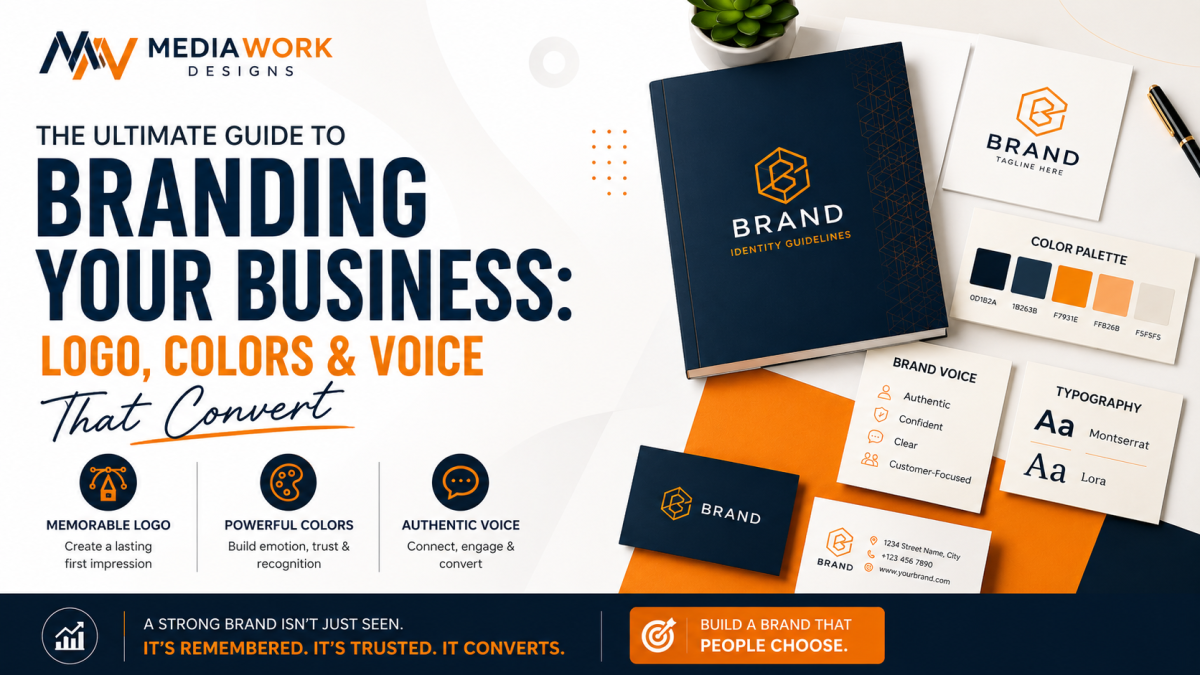
The Ultimate Guide to Branding Your Business: Logo, Colors & Voice That Convert
Your logo is the face of your business. Your brand colors trigger emotions before a single word is read. Your brand voice determines whether potential customers trust you — or scroll past.
Introduction
Branding isn't just for Fortune 500 companies. A strong brand identity is one of the highest-ROI investments a small business can make. According to Lucidpress, consistent branding across all platforms increases revenue by up to 23%.
This guide walks you through every element of building a brand that converts: from logo design and color psychology to brand voice, style guides, and applying your brand consistently across digital touchpoints.
What Is a Brand (and Why It’s More Than a Logo)
A brand is the total perception your customers have of your business — the sum of every interaction, every visual, every email, every phone call. Your logo is the symbol. Your brand is the feeling.
Strong brands build trust, command premium prices, attract better customers, and create loyalty that survives competition. Weak brands compete solely on price — a race to the bottom.
Logo Design: More Than Just Pretty Graphics
Your logo needs to work at a business card size and on a billboard. It must be memorable at a glance, communicate your industry, work in black and white, and be scalable without losing quality (vector format).
Common logo mistakes: too many fonts (limit to 2), too many colors (limit to 2–3), trendy designs that date quickly, and using clip art or generic stock icons.
Invest in a professional logo — it’s the foundation every other brand element builds on.
Color Psychology: Choosing Colors That Convert
Colors trigger specific psychological responses. Blue signals trust and professionalism (used by banks, tech companies, and most agencies). Green represents growth and health. Orange conveys energy and enthusiasm. Red creates urgency. Black suggests luxury and sophistication.
Choose a primary color that aligns with your brand’s personality and industry. Add 1–2 complementary colors for accents. Define exact hex codes and use them consistently everywhere — your website, business cards, social media, and physical materials.
Typography: The Unsung Hero of Branding
Typography communicates personality before the words are read. Serif fonts (like Times New Roman) feel traditional and trustworthy. Sans-serif fonts (like Arial, Montserrat) feel modern and clean. Script fonts feel personal and creative but should be used sparingly.
Choose a primary font for headings and a secondary font for body text. Limit yourself to 2 fonts maximum. Define sizes, weights, and usage rules in your brand style guide.
Brand Voice: How Your Business Sounds
Brand voice is the consistent personality and tone in all your written communication. Are you authoritative and professional? Friendly and conversational? Bold and direct?
Define your brand voice with 3–4 adjectives (e.g., ‘knowledgeable, approachable, results-driven, straightforward’). Then apply those descriptors to every piece of content: website copy, social media, emails, and ads.
Consistency in voice builds familiarity — and familiarity builds trust.
Creating a Brand Style Guide
A brand style guide is your brand rulebook. It documents all your brand elements so everyone who represents your business — contractors, employees, agencies — uses them consistently.
Your style guide should include: logo variations and usage rules, color palette with hex codes, typography specifications, image/photography style, brand voice and tone guidelines, and examples of do’s and don’ts.
Applying Your Brand Consistently Online
Brand consistency across digital touchpoints is critical for trust. Audit your current presence: Does your website match your social media? Do your email newsletters use the same fonts and colors? Are your business cards and digital assets aligned?
Every inconsistency erodes credibility. Consistent brands are perceived as more professional, more established, and more trustworthy — regardless of their actual age.
Conclusion
A strong brand doesn't just look good — it builds trust, attracts better customers, and supports premium pricing. Whether you're starting from scratch or refreshing an outdated identity, investing in professional branding is one of the smartest business decisions you can make.
Media Work Designs creates cohesive brand identities for small businesses across New York — from logo design and color palettes to full brand style guides. Ready to build a brand that stands out? Let's talk.