
Local SEO: The Complete Guide for Small Businesses to Dominate Google Maps in 2026
Imagine someone in your neighborhood picks up their phone and searches “local SEO for small business near me.” Does your business appear? If not, you’re invisible to one of the highest-intent audiences in digital marketing.
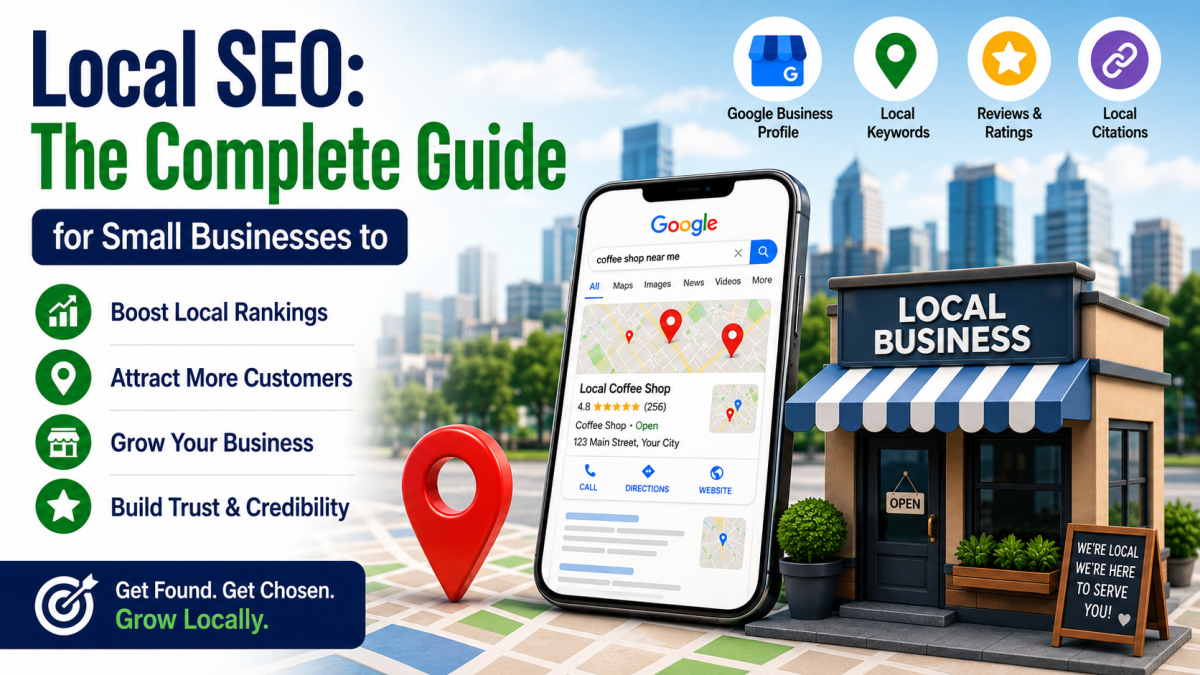
Introduction
"Near me" searches have grown by over 900% in the past five years, according to Google. These aren't casual browsers — they're people ready to buy, book, or visit. Local SEO is the key to capturing this audience.
This complete guide walks you through every element of local SEO in 2026: from Google Business Profile optimization to citation building, local content creation, and review management. By the time you finish reading, you'll have a clear roadmap to dominate local search results in your city.
What Is Local SEO and Why Does It Matter?
local SEO for small business is the process of optimizing your online presence to appear in location-specific search results. When someone searches “digital marketing agency Queens NY” or “plumber near me,” Google displays a “local pack” — a map with three business listings. Appearing there is worth thousands in free advertising.
For businesses that rely on local customers, local SEO is not optional — it’s survival. Consider: 46% of all Google searches have local intent, 76% of people who search for a local business on their phone visit within 24 hours, and 28% of those searches result in a purchase.
How Google Decides Who Ranks Locally
Google uses three key factors to determine local rankings:
Relevance: How well your business matches what the searcher is looking for. Optimize your GBP categories and website content for your core services.
Distance: How far your business is from the searcher or the location mentioned in the query. You can’t always control this, but targeting hyper-local keywords helps.
Prominence: How well-known your business is online — measured by reviews, backlinks, website authority, and citation consistency.
To rank locally, you need to optimize all three factors simultaneously.
Optimizing Your Google Business Profile
Your Google Business Profile is the centerpiece of local SEO. A fully optimized GBP consistently outperforms poorly managed ones in local rankings.
Key optimization steps: Choose the most accurate primary category and up to 9 additional categories. Write a 750-character description packed with relevant keywords. Add photos (businesses with photos get 42% more direction requests). Post weekly updates about services, offers, or events. List all services with detailed descriptions and prices. Enable messaging so customers can contact you directly.
Expert tip: The “Q&A” section of your GBP is often overlooked. Populate it with your own questions and answers using keywords. This content appears directly in search results.
Building Local Citations (NAP Consistency)
A citation is any mention of your business’s Name, Address, and Phone number (NAP) online. Consistent citations across directories signal to Google that your business is legitimate and established.
Start by claiming profiles on the core directories: Google Business Profile, Yelp, Bing Places, Apple Maps, Facebook Business, and industry-specific directories.
Critical: Your NAP must be identical everywhere. Even small differences like “Ave.” vs. “Avenue” or an old phone number can confuse Google and hurt rankings. Use a tool like Moz Local or BrightLocal to audit and fix inconsistencies.
Local Keyword Research: Finding the Right Terms
Local keyword research focuses on the geographic modifiers your customers actually use. Instead of “web design,” target “web design company Queens NY” or “affordable website designer New York.”
Effective local keyword formats include: [service] + [city], [service] near me, [service] in [neighborhood], best [service] in [city], and [service] + [zip code].
Use Google’s autocomplete feature, the “People Also Ask” section, and tools like SEMrush or Ahrefs to find keywords with commercial intent and manageable competition.
On-Page SEO for Local Businesses
Your website needs to signal your location clearly. Include your city and region in your page title tags, meta descriptions, H1 headings, first paragraph of content, image alt text, and footer (with a map embed).
Create a dedicated “Service Areas” page if you serve multiple neighborhoods or cities. Build individual location landing pages for each area with unique, localized content — not duplicate text with the city name swapped.
Add LocalBusiness schema markup to help Google understand your business details at a glance.
Earning Local Backlinks
Backlinks from local websites are SEO gold. They tell Google that your business is trusted and relevant in your community.
Where to earn local links: sponsor local events, join your city’s Chamber of Commerce, partner with complementary local businesses for cross-promotions, get listed on local news sites and blogs, and contribute guest posts to local industry publications.
Even a handful of strong local backlinks can significantly boost your local pack rankings.
Managing Online Reviews for Local SEO
Reviews are a direct local ranking factor. Google wants to show users businesses that others trust. More reviews + higher ratings = better rankings.
Build a system for collecting reviews: After each job or transaction, send a text message with a direct link to your Google review page. Train your team to politely ask satisfied customers for reviews. Respond to every review within 48 hours — Google factors your response rate into rankings.
Aim for a consistent flow of new reviews (2–4 per month minimum) rather than a burst followed by silence.
Creating Location-Specific Content
Local content signals relevance to Google and builds trust with local searchers. Ideas include: neighborhood guides (“Best Restaurants Near Jamaica, Queens”), local case studies featuring recognizable neighborhoods, blog posts about local events or community involvement, and FAQ pages addressing locally-specific questions.
This type of content is rarely produced by national competitors, giving local businesses a significant ranking advantage in their area.
Conclusion
Local SEO is one of the highest-ROI investments a small business can make. When done right, it delivers a steady stream of qualified, ready-to-buy customers directly from Google — for free.
At Media Work Designs, we specialize in local SEO for small businesses in New York and beyond. From GBP optimization to citation building and local content strategy, we handle everything. Ready to show up when it matters most? Get your free local SEO audit today.