
What Is Technical SEO and Why It Can Make or Break Your Website Rankings
You’ve written great content. You’ve built solid backlinks. But your website is still buried on page 3 of Google. Sound familiar?
Introduction
The missing piece is often technical SEO guide — the foundation that everything else sits on. Think of it this way: you can write the world's best content, but if search engines can't properly crawl, index, or understand your website, that content might as well not exist.
Technical SEO is the process of optimizing your website's infrastructure to help search engines access, crawl, interpret, and index your site efficiently. In 2026, with Google's Core Web Vitals and AI-powered ranking algorithms, technical SEO is more important than ever. This guide explains exactly what it is, why it matters, and what you need to fix right now.
What Is Technical SEO?
Technical SEO refers to all optimizations that help search engines crawl and index your website more effectively. Unlike on-page SEO (which focuses on content) and off-page SEO (which focuses on backlinks), technical SEO focuses on your website’s infrastructure.
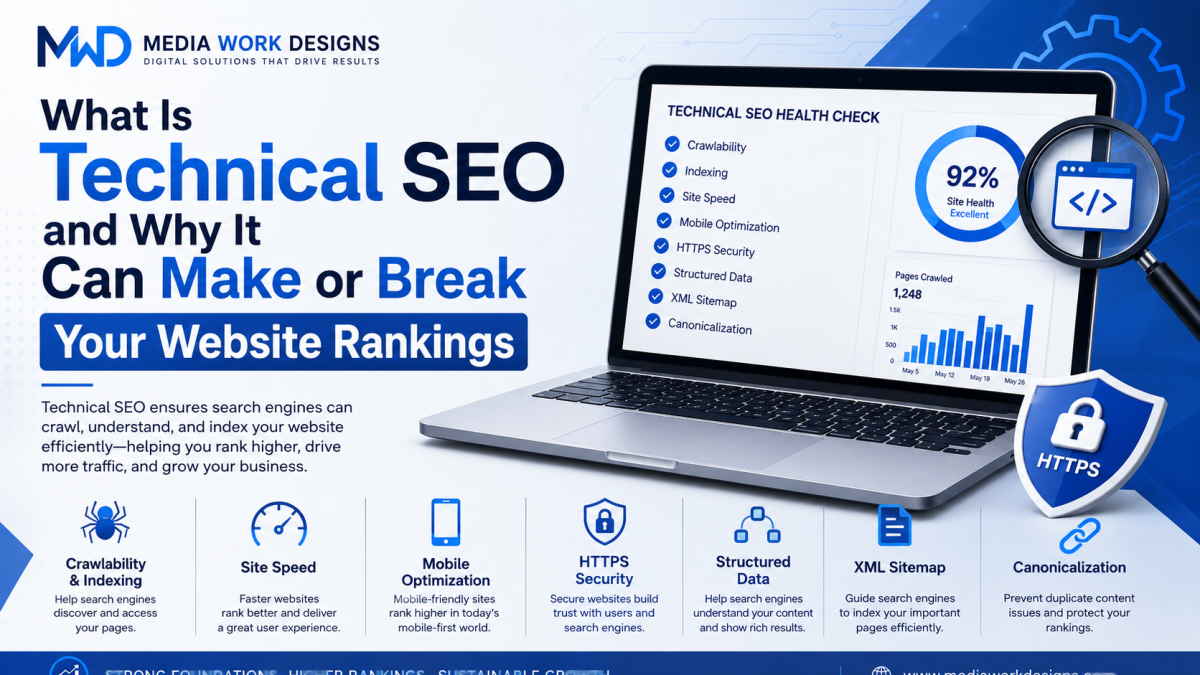
Key areas of technical SEO include: site speed and Core Web Vitals, mobile-friendliness, website security (HTTPS), crawlability and indexation, site architecture, XML sitemaps, structured data markup, and URL canonicalization.
Without a strong technical foundation, all your content and link-building efforts will underperform.
Core Web Vitals: Google’s UX Report Card
In 2021, Google made Core Web Vitals an official ranking factor. These three metrics measure user experience:
Largest Contentful Paint (LCP): Measures how quickly the largest element on a page loads. Target: under 2.5 seconds. First Input Delay (FID) / Interaction to Next Paint (INP): Measures interactivity responsiveness. Target: under 200ms. Cumulative Layout Shift (CLS): Measures visual stability (does the page jump around?). Target: under 0.1.
Pages that fail Core Web Vitals are penalized in rankings. Use Google’s PageSpeed Insights tool to check and improve your scores.
Crawlability and Indexing
If Google can’t crawl and index your pages, they won’t rank — period. Common crawlability issues include: pages accidentally blocked in robots.txt, noindex tags left on production pages, broken internal links creating dead ends, and duplicate content without proper canonicalization.
Set up Google Search Console (free) to monitor your Coverage report. It shows which pages are indexed, which are excluded, and why. Fix any “errors” and “warnings” immediately — these are pages Google wants to rank but can’t.
HTTPS and Website Security
HTTPS is a confirmed Google ranking signal. If your website still uses HTTP (no SSL certificate), you’re at a disadvantage — and modern browsers actively warn users that your site is “Not Secure,” destroying trust and increasing bounce rates.
Most web hosts provide free SSL certificates through Let’s Encrypt. There’s no reason for any website to be running without HTTPS in 2026. Install your SSL certificate, then redirect all HTTP traffic to HTTPS to avoid duplicate content issues.
Mobile-First Indexing
Since 2023, Google uses your mobile website as the primary version for indexing and ranking. This means if your mobile site is slow, hard to navigate, or missing content that’s on your desktop version, your rankings will suffer.
Test your mobile experience with Google’s Mobile-Friendly Test tool. Ensure your font sizes are readable without zooming, buttons are large enough to tap, and no content is hidden on mobile.
Site Architecture and URL Structure
Good site architecture helps both users and search engines navigate your website efficiently. Follow the rule of three: no page should be more than 3 clicks from your homepage.
SEO-friendly URL best practices: use lowercase letters, replace spaces with hyphens, include your primary keyword, keep URLs short (under 60 characters), and avoid dynamic parameters (?id=123).
Example: mediaworkdesigns.com/local-seo-services is better than mediaworkdesigns.com/services?cat=12&id=847
Structured Data and Schema Markup
Schema markup is code added to your website that helps Google understand your content better. It can enable rich results in search — like FAQ dropdowns, star ratings, event dates, and business information.
For local businesses, implement LocalBusiness schema. For e-commerce, use Product and Review schema. For blog content, use Article and FAQ schema.
Schema markup doesn’t directly boost rankings, but it increases click-through rates by making your search listings more visually appealing and informative.
Conclusion
Technical SEO is the invisible engine powering your website's search performance. Without it, even the best content and strongest backlinks won't deliver the rankings you deserve. The good news? Most technical SEO issues are fixable — you just need to know where to look.
Media Work Designs provides comprehensive technical SEO audits and implementation for small businesses and growing brands. Let us find and fix the technical issues holding your website back. Schedule your free SEO audit today.