
WordPress vs. Shopify: Which Platform Is Right for Your Business in 2026?
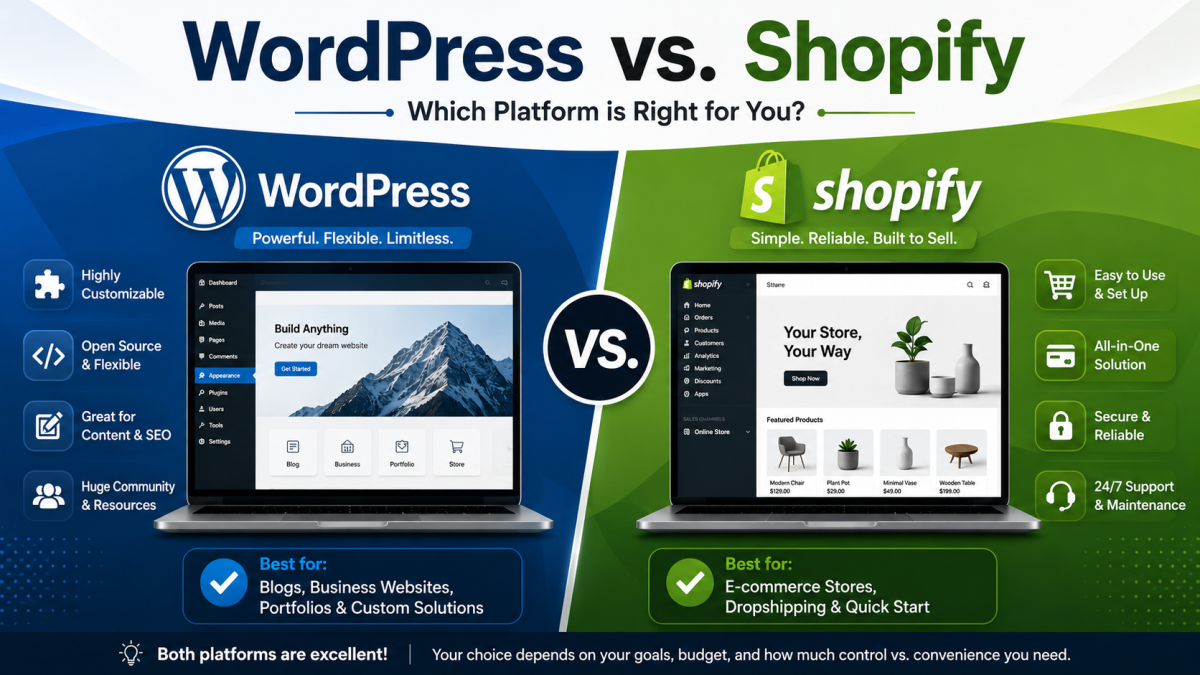
You’ve decided to build or rebuild your website. Now you’re staring at two of the biggest names in the industry: WordPress and Shopify. Both are excellent — but for very different purposes.
Introduction
Choose the wrong platform, and you'll spend thousands fixing it later. Choose the right one and your website becomes a lead-generating, revenue-driving machine from day one.
In this guide, WordPress vs Shopify, we compare every dimension that matters for business owners in 2026: ease of use, SEO capabilities, cost, design flexibility, scalability, and e-commerce functionality. By the end, you'll know exactly which platform fits your business goals.
WordPress vs. Shopify: Quick Overview
WordPress is an open-source content management system powering 43% of all websites. It’s incredibly flexible but requires more technical management. Shopify is a dedicated e-commerce platform designed to make selling online as simple as possible.
Simple rule: If you want to SELL products online as your primary function, Shopify is typically the better starting point. If you need a content-heavy website with e-commerce as a secondary function — or need maximum customization — WordPress wins.
Ease of Use
Shopify wins here. Its drag-and-drop interface, guided setup, and 24/7 support make it accessible even for non-technical users. You can have a basic store live in a day.
WordPress has a steeper learning curve. Managing hosting, installing plugins, and troubleshooting compatibility issues requires more technical comfort. That said, with a good theme and page builder (like Elementor or Kadence), WordPress becomes much more manageable.
For business owners who want to manage their own site without relying on a developer, Shopify’s simplicity is a major advantage.
SEO: Which Platform Ranks Better?
WordPress has traditionally had the edge in SEO due to its flexibility, powerful plugins (like Yoast SEO and Rank Math), and ability to create complex content structures.
Shopify has improved significantly. It handles technical SEO well out-of-the-box — canonical tags, XML sitemaps, and mobile optimization are all automatic. But its URL structure (with “/collections/” and “/products/” prefixes) and limited blog functionality give WordPress a slight SEO advantage for content-heavy strategies.
For pure product-based SEO, Shopify is fully capable. For businesses investing heavily in content marketing and blog-driven SEO, WordPress is the stronger long-term choice.
Design and Customization
WordPress offers virtually unlimited design possibilities. With thousands of free and premium themes plus page builders, you can create any design imaginable — or build fully custom from scratch.
Shopify has excellent themes (both free and paid at $150–$350) designed specifically for e-commerce conversion. Customization is more limited than WordPress but covers the needs of 95% of online stores.
If brand differentiation through unique design is a priority, WordPress gives you more freedom.
E-commerce Features
Shopify was built for e-commerce. It includes everything out of the box: payment processing (Shopify Payments), inventory management, shipping calculations, abandoned cart recovery, discount codes, and analytics.
WordPress with WooCommerce is nearly as powerful but requires more setup. You’ll install WooCommerce plus additional plugins for subscriptions, advanced shipping, and payment gateways. This flexibility is powerful but requires more maintenance.
For a new e-commerce store, Shopify gets you selling faster with less setup friction.
Pricing: True Cost Comparison
Shopify pricing: Basic ($29/month), Shopify ($79/month), Advanced ($299/month), plus 2.9% + 30¢ transaction fees unless you use Shopify Payments.
WordPress pricing: Free platform + hosting ($5–$50/month), domain ($15/year), premium theme ($50–$100), plugins ($100–$500/year), and maintenance costs.
For low-revenue stores, WordPress can be cheaper. As your store scales past $500,000/year in revenue, Shopify’s transaction fees become significant — but so does the value of its built-in tools.
Always calculate the true total cost including your time and developer fees.
The Verdict: When to Choose Each
Choose Shopify if: you’re primarily selling products online, want a fast setup with minimal technical hassle, need robust e-commerce features out of the box, and have straightforward content needs.
Choose WordPress if: content marketing is central to your strategy, you need maximum design customization, you’re building a membership site or complex custom functionality, or your site is more informational than transactional with e-commerce as a secondary feature.
Conclusion
Both WordPress and Shopify are excellent platforms — the right choice simply depends on your specific business goals, technical comfort level, and long-term growth plans. Don't let analysis paralysis delay your launch.
Not sure which platform is right for you? Media Work Designs builds professional websites on both WordPress and Shopify, tailored to your specific business needs. Let's talk — schedule a free consultation and we'll recommend the perfect platform for your goals.